If you’ve ever left a meeting full of great ideas but unsure of what comes next, you’re not alone. The goals were clear. The energy was high. Everyone was in agreement. And then work resumes as per usual. That lingering “now what” feeling is exactly why a Goal Action Plan matters.
Action planning is the bridge between good intentions and real outcomes. It turns strategy into steps, vision into progress, and conversations into action. For leaders focused on business strategy implementation, effective action planning for teams is how workplace goals stop being abstract and start producing measurable results. When done well, it’s also how teams become high‑performing teams
An action plan, sometimes called a Goal Action Plan, is a clear, practical roadmap for achieving a specific goal.
Think of it as the bridge between vision and execution. It translates big ideas into specific tasks, timelines, and responsibilities so progress becomes measurable and momentum becomes intentional.
I still remember the first time I walked through a truly thorough action plan with a team I was leading. When we finished mapping everything out, tasks, timelines, responsibilities, I looked at it and thought, this is marvelous.
For the first time, I felt relief as a leader. I didn’t need to keep generating big, grand ideas on my own. We had created this plan together, drawing on multiple perspectives and experiences, and all we had to do was follow it.
Yes, we still had to review and adjust along the way, but that felt far easier than constantly reinventing the path from scratch. There was something grounding about being able to say, “It’s simple, all we have to do is follow the plan.”
That experience, and the shift in performance that followed, showed me how powerful action planning can be.
At its core, an action plan answers six essential questions:
Action planning is where decisions become doable. It creates enough structure to establish accountability, while still allowing flexibility as real work unfolds.
Leaders often assume that once a team agrees on a goal, the rest will fall into place. In practice, that’s rarely what happens. Most teams leave goal‑setting conversations feeling aligned and energized, only to return to their desks and slip back into old patterns.
The issue isn’t motivation or capability. It’s that the conversation stopped too soon.
A significant percentage of Business Strategy Implementation efforts fail not because the goals were flawed, but because teams never aligned on how the work would actually unfold. People walk out of the same meeting with completely different interpretations of what matters most, what’s changing, and what they personally need to do next. That false sense of alignment is one of the most common and costly breakdowns in organizational life.
I’ve seen this play out countless times. A team agrees on a direction, everyone nods enthusiastically, and then nothing meaningfully changes. Not because anyone is resisting, but because no shared decisions were made about focus, priorities, or ownership. The goal is clear, but the path is foggy.
Without those decisions, goals become abstractions, important and inspiring but disconnected from the day‑to‑day reality of competing demands. People end up improvising in isolation. Effort scatters. Priorities drift. Leaders misinterpret the resulting friction as disengagement, when in reality the team simply didn’t have the structure to succeed.
Alignment on what is never a substitute for alignment on how, they both need to exist. The organizations that consistently deliver results aren’t the ones with the boldest goals, they’re the ones that treat execution as a shared discipline, not an afterthought.
When a team takes the time to build an action plan together, the work changes, and so does the team.
It creates a shared direction people can actually move toward. Not a slogan. Not a goal statement. A direction that feels real and doable. People stop guessing and start taking intentional action.
This is why Action Planning for Teams is so powerful, it shifts the work from individual effort to coordinated progress.
It also focuses the team’s effort and energy. When everyone is moving in the same direction, the work becomes more efficient. You can lean on each other’s strengths, coordinate instead of collide, and make progress with far less strain. Focused effort makes the work feel lighter because it’s no longer scattered across competing interpretations of what matters.
It takes weight off the team in other ways too. So much friction comes from unspoken assumptions, unclear expectations, and decisions that never get made. A good action plan removes that noise. People stop second‑guessing and start contributing with more confidence.
And something else happens that’s easy to overlook, leadership becomes shared. When the plan is visible and co‑created, responsibility doesn’t sit with one person anymore. The team starts steering together. The leader isn’t the only one holding the whole picture.
Momentum builds. Trust grows. The work gets easier because the path is no longer being reinvented every week. That’s the real impact of action planning, it’s the shift that turns a capable group into a truly High‑performing Team. It’s also why teams that invest in this work consistently outperform peers who rely on good intentions alone.
Action planning is useful anytime you want to turn a decision into movement, but it becomes especially important when:
If you’ve ever wondered, “Are we actually doing this, or just talking about it?” that’s your cue.
The gap between strategy and execution is where most organizations stumble. A Goal Action Plan is the practical tool that closes that gap.
When strategy is translated into sequenced steps, clear ownership, and measurable milestones, implementation stops being an abstract hope and becomes a repeatable process. That’s how strategy stops being a document and starts being delivered.
There’s something leaders often learn the hard way, when action planning is missing, everything funnels back to the leader.
Teams wait for direction. Decisions pile up. Progress slows. Leaders feel like they’re carrying the entire effort on their backs, even when they’re surrounded by capable people.
Action planning changes that dynamic.
When people understand the plan, and the thinking behind it, they make stronger, more independent decisions. Authority spreads. Autonomy grows. The leader doesn’t disappear, but they’re no longer the only one holding the whole picture or pushing the work forward.
This is how leadership becomes shared instead of centralized.
A useful action plan isn’t rigid. It’s alive.
Priorities shift. Constraints show up. New information emerges. A good plan adapts with the work instead of becoming something you file away and forget.
Yes, action planning takes time upfront. But it saves far more time, energy, and frustration later. It’s how teams stop being “the group that never follows through on great ideas” and start becoming the team that actually gets it done.
If your organization has strong ideas but struggles to turn them into consistent action, the issue may not be motivation or capability.
It may simply be that the bridge between goals and execution hasn’t been built yet.
And that’s fixable.
Michelle Nicole Martin
Team Performance and Leadership Consultant & Coach
Connect with me on LinkedIn
“Michelle, I don’t need to be recognized in front of people.”
John said this gently, almost apologetically.
We were talking about how he preferred to receive appreciation, and I remember feeling a bit… disappointed. It didn’t feel like public recognition to me. It felt like acknowledging someone whose contribution made the whole team better. I wanted to openly tell the team all about it; I wanted them to know the subtle yet powerful ways that John made everyone’s life easier.
I told him, “I just feel like you add so much value. Sometimes ‘thank you’ doesn’t feel like enough.”
That was the disappointment — thank-you didn’t feel like enough, so I wanted to give a really BIG, PUBLIC thank-you.
He smiled and said, “But your thank-you is enough for me. Knowing you see it… that’s what matters.”
That hit me.
Because what he was actually telling me wasn’t just a preference, it was his workplace genius expressing itself.
John embodies the Genius of Enablement.
Those whose genius is Enablement are the steady hands who respond when there’s a need and quietly help others move forward. They don’t require a spotlight; being useful is what energizes them. They’re often the glue in a department, the bridge, the helper, the person others rely on.
Enablement is powerful.
But like every genius, it has a shadow.
People with this working genius can over-yes. They take on too much and their desire to help becomes the very thing that causes their overwhelm.
We can all appreciate that once we understand someone’s natural work style, it becomes easier to support them in a meaningful way. But that kind of insight usually takes time… trial, error, and a lot of guesswork.
I wanted something that could speed up the learning curve. A framework that put language around moments like this so I could meet my team as they were, not just as I am.
Shortly after that conversation, I discovered a framework that explained how people connect to their work, not just another personality test.
It's called the 6 Types of Working Genius.
There are six types of genius represented in the Working Genius model; six parts of work where people may feel naturally strong, capable, and energized.
To get started, individuals or teams take the Working Genius Assessment to understand their two core work strengths, what types of work they can manage, and what quickly drains them.
Every job requires all six types of working geniuses:
Everyone has all six, but some give energy while others drain it:
Once you begin to notice what type of work aligns best with an employee, work becomes easier to guide, collaborate on, and complete, without burning people out.
If you’re curious to learn more, this episode of the Working Genius Podcast with Patrick Lencioni is a great place to start (and it’s free): No Joy No Genius
In this episode, Pat and the Working Genius team dive into the importance of fulfillment and joy in determining what your Geniuses are.
Once you understand workplace genius, you begin to see patterns everywhere.
Some people instinctively explore possibility and ask great questions. You might find yourself thinking, “Wow… great question.”
Others jump quickly into creating new approaches. If this is your workplace genius, you might hear compliments like, “You’re so creative,” or “Great idea!”
Some evaluate ideas and sense what will realistically work; you just trust their judgment.
There are teammates who naturally rally others to get things moving; the spark, the catalyst.
Some step in to support and help, just like John. We all need a little help along the way.
And others feel great satisfaction finishing the work and hitting the target; the ones who love crossing items off the to-do list.
These aren’t small quirks.
They are signals, revealing the work strengths people bring to the table and where they naturally shine.
This doesn’t mean people should only do work they do best, that’s not realistic.
It simply means that when people spend a meaningful portion of their time doing work that energizes them, they have the grit and resilience to tackle the tasks that drain them.
This is one of the aspects I love most about being a team coach: helping groups build self-awareness by learning their unique strengths while also understanding the strengths of their peers.
During a Working Genius workshop, we explore each person’s Working Genius assessment results, which reveals the work that energizes them, along with the tasks that tend to drain them. Then we map where each participant fits within the six parts of work so the team can see how everyone contributes.
In the best way… you’ll never look at each other the same way again.
Burnout isn’t only about workload.
More often, it comes from spending too much time in work that sits in our frustration zone.
Think about work styles like battery life:
People operate the same way.
Strong performers rarely complain, they will do whatever is needed but if most of their day involves work that drains them, they’re likely grinding through. The more time they spend outside their genius, the faster their battery loses charge.
According to Gallup, these engaged employees are 61% more likely to burn out.
Why? Because they’re reliable so they come through. But reliability without replenishment erodes employee well-being because the joy and fulfillment in their work is not there.
What if we repaid them by giving them work that boosts their batteries rather than drains them?
To stay healthy and effective, people need regular access to work that recharges them, work that aligns with their workplace genius. When that happens, they gain energy back... work becomes regenerative. And that energy boost helps them take on tasks that is draining for them without burning out.
When leaders understand their team’s workplace genius, something important shifts, they stop confusing motivation with capability.
Too often, we judge others through our own work strengths.
If something seems straightforward to us, we assume it should feel the same for everyone. When it doesn’t, we label the resistance as attitude, lack of initiative, or poor performance.
But workplace genius works more like those hidden-image posters. You know the ones that look like random patterns and colors; you’re supposed to stare into the center and let your eyes relax until suddenly… an elephant appears.
I’m terrible at those!. And yet some people see the image right away.
The 6 Types of Working Genius works the same way.
Once you realize someone simply can’t see what you see, the frustration eases.
You stop thinking, “Why can’t they just do this?”
And you start getting resourceful, “Which part of this work is theirs to lead and where might someone else be a better fit?”
That’s the real unlock.
Leaders who embrace this don’t lower expectations, they align them.
They put people where they contribute most naturally and build support around the areas that drain them.
When that happens, collaboration changes:
This is more than smoother workflow, it’s psychological ease. Teams experience less judgment or guilt and more partnership.
This type of shift is where a team coach or workshop facilitator can accelerate change; helping teams map their work styles, understand how the 6 Types of Working Genius show up in real conversations, and redesign collaboration so strengths are shared rather than siloed.
If workplace genius is something you want to explore, or if you’re seeing burnout, bottlenecks, tension across functions, or misalignment, I’d love to help.
As a workshop facilitator and team coach, I guide leadership teams through Working Genius workshops to:
And of course, the engagement kicks off with the most fun part, the Working Genius Assessment. I set this up for you; it takes less than 3 minutes to complete and bam, you get your report with personal insights. I especially love the Genius Pairings section.
If you’re curious what this could look like for your team, let’s talk. → Book a Working Genius Workshop
Work feels different when you’re operating in your genius. There’s more flow, more clarity, and more fulfillment; not just in what gets done, but in how it gets done.
That’s the real promise of understanding your workplace genius: everyone contributes in the way they’re wired to contribute.
So I’ll leave you with this:
What is your workplace genius?
And what might change once you know?
Michelle Nicole Martin
Leadership Coach & Consultant
Connect with me on LinkedIn
There’s a line on page 52 of The 6 Types of Working Genius that stopped me in my tracks:
“You can go from frustrated to inspired in seconds and I’d like to know what causes that.”
That line pulled me in because it’s exactly how I’ve felt at work. One moment, I can be stuck in frustration, and the next, I’m fully energized and creative again. I wanted to understand why that happens.
As a long-time Patrick Lencioni fan, I bought the book expecting another great story about leadership and teamwork. What I didn’t expect was to feel like the book was written about me and to find a model that finally explained how the parts of work impact me.
The aha moment for me came when I realized:
Just because you’re capable of doing something doesn’t mean you should do it or that you’re the best one to do it.
That insight was freeing. Because as a senior leader, I was used to doing what was “required” even if it drained me. I believed that being responsible meant “suck it up buttercup”. But the truth is, not everything that we’re good at fuels us. Some things simply drain our batteries, no matter how competent we are.
Unlike personality assessments, which tell you who you are, the Working Genius reveals which parts of work give you energy and fulfillment. It’s a productivity tool, not a personality profile.
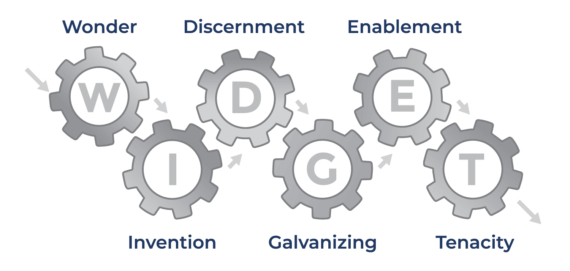
It breaks down work into six stages: Wonder, Invention, Discernment, Galvanizing, Enablement, and Tenacity (WIDGET, for short).
Each of us naturally thrives in two of these areas, our Working Geniuses. Feels competent in two, our Working Competencies and struggles in the last two, our Working Frustrations.
The magic happens when you understand your natural genius and begin leveraging the complementary strengths within your team.
One of my clients stands out vividly in my mind. She had the Genius of Discernment, that intuitive ability to sense whether an idea or plan will work. She’s incredibly talented at spotting gaps, inconsistencies, or potential pitfalls in strategies before others can see them.
But to her team, that gift often came across as controlling or overly critical. She’d ask questions that others weren’t ready for. People started to think she believed only her ideas were good ones.
When we explored her Working Genius results together and I described how she is misunderstood, she had this moment of visible relief. She said, “Wow, that’s exactly it, I feel like you get it.”
That’s the challenge with a mismanaged Genius. Because she wasn’t trying to be difficult, she cared deeply about the success of her team and the business. Her challenge wasn’t that she had discernment; it was that she didn’t yet know how to use it effectively.
We worked on strategies to channel her discernment in more productive ways, guiding her to slow down, ask permission to “think out loud,” and help others walk through their own decision-making process instead of jumping straight to her conclusion.
Like any muscle, it took practice. But over time, she developed new tools and habits that allowed her to keep her genius intact without unintentionally shutting down her team’s creativity and engagement.
Here’s something people don’t talk about enough: when our geniuses, competencies or frustrations aren’t understood, they often trigger guilt and shame.
We feel guilt when our natural energy doesn’t align with our responsibilities. We feel shame when others interpret our gifts as flaws. And we judge others for not seeing or doing things the way we would.
The Working Genius gives language to those experiences and permission to let them go.
It helps leaders see that their frustrations don’t make them weak or broken; they make them human. The key is learning how to manage those frustrations effectively and surround yourself with others whose geniuses complement yours.
The working Genius brings more fulfillment, productivity, quality and belonging to the workplace. Through the Working Genius, you can improve team dynamics and collaboration by helping individuals find their working passion and where everyone fits within W.I.D.G.E.T.
The working Genius provides teams with a common language and a better way to manage their dynamics, projects and meetings in a way that actually brings joy and fulfillment to all.
As individuals, we all want to be seen, heard and understood. With this tool, we can recognize, respect and utilize each other to meet our personal needs. Arguably a tool that helps combat some situations that cause burnout, quiet quitting and imposter syndrome.
For me, Tenacity is a Working Frustration.
For years, I carried guilt around the feedback, “You start more projects than you finish.” I’d hear it and think, How can I be a good leader if I don’t have a natural drive to see things through?
I held some shame about the idea that completing a to-do list didn’t jazz me at all. I was responsible for results! How on earth could I hate a to-do list?
But once I understood the six parts of work and that Tenacity isn’t my Genius, it’s my Frustration, it suddenly seemed ok.
I stopped judging myself for not being wired to finish every project, and instead started asking, Who on my team is naturally gifted at seeing things through?
Turns out, I had people whose Tenacity was their Genius. They loved bringing ideas to completion. I held onto so much because I thought it was my responsibility and to realize that someone else was energized by doing the work that drained me was extremely eye-opening. It became almost selfish to not delegate the work to them. By giving them ownership and support, we started finishing more projects and faster than I ever could have achieved alone.
Now, I see the parts of work as a relay race. Each person runs their leg with energy and focus, then passes the baton to the next. When everyone operates in their zone of genius, the whole team moves faster and more cohesively. No one burns out trying to do it all.
When I facilitate Working Genius workshops, I encourage participants to think outside of their job description, the real question is:
“What gives you energy?”
From there, we move into visual exercises, sticky notes, battery levels, and group comparisons, that make the invisible visible. Teams quickly see which stages of work fuel them, and which drain them.
The most powerful moment always comes when they compare notes and realize, Oh, what drains me actually energizes you.
That’s when real collaboration starts.
I also help participants verify their Working Genius assessment results. Sometimes people get caught up in the “I’m good at this” or “This is my job” mindset. I remind them, this isn’t about skill; it’s about energy. You can be good at something that still leaves you depleted at the end of the day.
The goal is not to avoid your frustrations entirely, that’s impossible, but to design work so that you and your team spend more time operating in your geniuses.
The biggest surprise I’ve seen in leaders who use the Working Genius isn’t just improved productivity. It’s relief.
Relief from guilt.
Relief from judgment.
Relief from feeling like you have to be everything to everyone.
It opens up honest conversations about who we are, what we love, and how we can best support each other. And when that happens, teams bond in deeper ways and great work happens.
Because when the heart of the great work is people and at the heart of people is connection.
Imagine what could happen if your team spent most of their day doing work that energized them.
How much better would your results be?
How much stronger would your relationships become?
We don’t need to force everyone to be good at everything.
We just need to understand where our natural strengths lie and build teams that allow those strengths to shine.
If this idea sparks curiosity for you , if you’re wondering what it might look like to apply the Working Genius with your team or inside your organization, I’d love to explore that with you.
Let’s talk about how your team can do more of the work they love and love more of the work they do.
Michelle Nicole Martin
Leadership Coach & Consultant
Connect with me on LinkedIn
The Working Genius workshop is a powerful tool for enhancing productivity, collaboration, and fulfillment in both teams and individuals. In this engaging and interactive workshop, participants will explore the six types of Working Genius to discover the work that brings them passion and joy, leading to increased energy and effectiveness in their professional lives.
This tool is for individuals and intact teams who want to lean into their Genius, creating an environment that supports strengths and collaboration.
As an individual, if you want to understand more about who you are, what comes naturally, and to stop feeling guilt for the tasks you're "supposed" to do but fail to bring out your best, the Working Genius can help. We don't need to be good at everything - we just need to know who to recruit to fill our working gaps.
For teams, if you want to recognize the gifts of one another and tailor work when possible, then the Working Genius is for you. This tool can bring a team together to synergize, shifting away from individuals who simply work together to a cohesive unit that leverages each other's strengths.

The Working Genius assessment is a tool that focuses 20% on personality and 80% on productivity. While I will focus on this tool's work applications, families, social groups, and even marriages can benefit from the Working Genius.
Every project, task, assignment, family vacation, or event is always a six-part Working Genius job. The six parts correlate to a Genius: W.I.D.G.E.T., which stands for Wonder, Invention, Discernment, Galvanizing, Enablement and Tenacity.
Every job we do requires these six Geniuses, and all six are equally important. You are capable of all six, but only two bring you true joy and fulfillment, two bring you frustration, and two are within your working competency. More on that soon - first, let's explore the six Geniuses in detail.
The person who asks why? Is it enough? or is there something more? The person who ponders what is happening and whether a person or project is reaching its full potential. So often criticized for a perceived lack of buy-in due to the non-Wonder's misunderstanding of the intent behind the questions. Make no mistake - Wonder is a Genius when asking critical questions that spark the Invention Genius to solve the right problem.
When Wonder asks, "Ever wonder why we never hit the target in this area?" Invention says, "I can solve this problem. I can find a solution". Invention has empathy for the question. Solutions are accessible for the Invention Genius to pull out, especially when Wonder sparks a need for change.
Not all inventions are good - here is where the Genius of Discernment comes in. Through intuition and instincts, the Discernment Genius knows how to gather information and come to reasonable solutions and advice. Discernment is not expertise - This Genius can naturally evaluate situations thoroughly and efficiently, even if they are not a topic expert.
When the job gets to G, this Genius can say, if this project is worth doing, I will rally, organize and inspire people to take action. Now, how incredible is this Genius? This person makes even the mundane tasks look shiny - combined with getting everyone on the same page, the G creates the momentum needed to get the team in gear.
Normally, the first follower of the Galvanizer, the Enablement Genius, can help with their incredible support to move the project along. This Genius is often selfless, incredibly supportive and underappreciated. As a D/I/G, I am sensitive to finding an E as a partner because I know I'm dead in the water without them. However, this Genius knows how to help and when to help - they are so dynamic and the gateway to Tenacity.
The finisher responding to the need to see a project, task or assignment finished and to achieve the desired results. This Genius gets absolute satisfaction from checking the box, completing the project and saying - this idea is now in the world because Tenacity crossed the finish line. This Genius lands the darn plane, hallelujah.
After going through all six Genius', it's indisputable that all are equally important and required to complete something effectively. So the only questions remaining are, which Genius are you? And which Genius' are around you?
Right Here, with me, Michelle Nicole Martin, check out my Leadership Development Workshops.
To learn more about how the Working Genius workshop can benefit your team or individual work life, book a discovery session with me today!
The Working Genius brings more fulfillment, productivity, quality and belonging to the workplace. Through the Working Genius, you can improve team dynamics and collaboration by helping individuals find their working passion and where everyone fits within W.I.D.G.E.T.
The working Genius provides teams with a common language and a better way to manage their dynamics, projects and meetings in a way that actually brings joy and fulfillment to all.
As individuals, we all want to be seen, heard and understood. With this tool, we can recognize, respect and utilize each other to meet our personal needs. Arguably a tool that helps combat some situations that cause burnout, quiet quitting and imposter syndrome.
When a team embraces the Working Genius, they respect and see each other for the Genius they bring to the table and utilize each other's Genius to divvy up the workload.
Working Genius
When working in your Genius, your energy may feel everlasting. Work doesn't feel like work - in fact, it energizes you!
Working Competency
Your energy is not everlasting here, so be mindful of how much time you spend in your Competency. The Working Competency is the danger burnout zone. Tricky because you're good at your Competency, maybe even great, but it's not the work that brings you joy, so when overused, you'll feel overused.
Working Frustrations
All joy and energy is gone when working in these areas. You may even feel guilt or shame regarding your Working Frustration.
For example, Tenacity is my Working Frustration. There was a time when I carried guilt and shame around the feedback "You start more projects than you finish." This made me feel like I was falling short as a leader. How could I be effective if I didn't have a natural drive to see things through to completion? But then I realized that we don't need to be good at everything - what matters is understanding our strengths and learning to manage our weaknesses effectively.
Once I accepted this, I was able to find a solution. I discovered that there were people on my team who had Tenacity as their Working Genius. By recruiting their help and delegating the task of finishing some of the great ideas I had started, we were able to achieve much more together than I could have alone.
Now, I see it as a relay race - each team member plays a crucial role, and we all work together towards a common goal. By focusing on our individual Geniuses and supporting each other in our Frustrations, we create a harmonious and productive work environment where everyone feels valued and fulfilled.
The Working Genius is a powerful tool for unlocking passion and productivity in both individuals and teams. By understanding the six types of Genius and how they contribute to the overall success of a project, you can create a more fulfilling and effective work environment. Ready to discover your Working Genius and transform your team's dynamics?
Book a discovery session with me today to learn more about how a Working Genius workshop can benefit you and your organization.
Michelle Nicole Martin
Leadership Coach & Consultant
Connect with me on LinkedIn