Everything DiSC® Workplace is a tool that helps people work better together. It's not just for managers or HR, it's for anyone who communicates, collaborates, or needs to understand why some working relationships click and others don't.
With personalized insights and actionable strategies, participants learn how to adapt to the style of others, ultimately improving engagement, collaboration, and the overall quality of the workplace.
As a certified Everything DiSC Facilitator, I see firsthand how much individuals and teams enjoy this tool. It's simple, versatile, and immediately applicable. Let me take you on a mini DiSC tour.
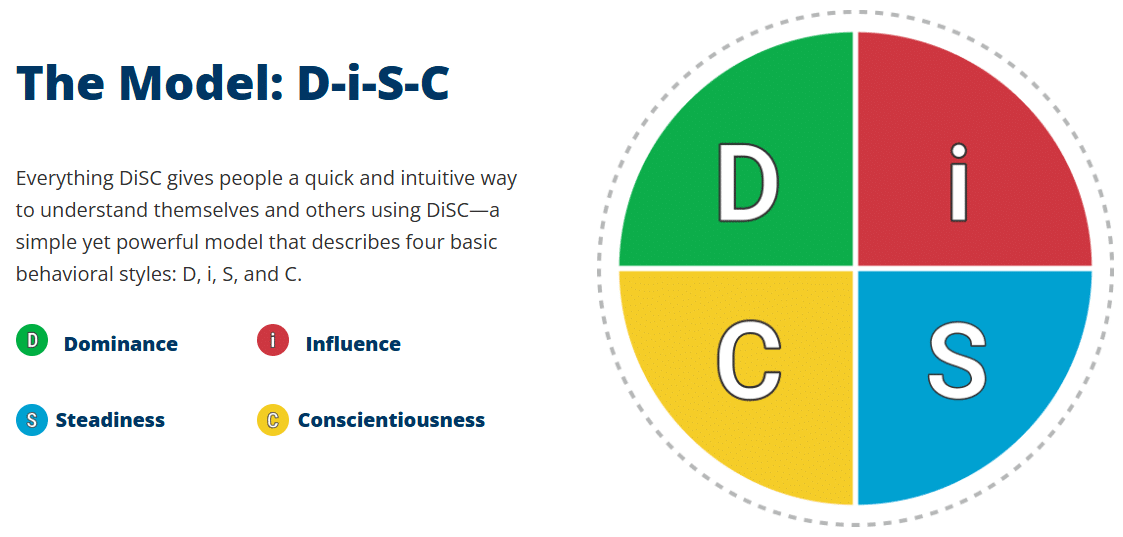
Everyone is a blend of all four styles, with one or two typically showing up more strongly. All styles are equally valuable, and each brings important strengths to a team.
It’s also important to note that DiSC doesn’t measure personality, intelligence, or skill. This research-backed assessment focuses on providing insights on observable behavioral tendencies and preferences.
The simplicity of the model is what makes it so powerful: people remember it, use it, and reference it long after the workshop ends.
While the DiSC model explains behavior, Everything DiSC Workplace turns that understanding into practical, everyday application.
It provides:
Organizations choose DiSC because it's:
If you’re curious about how to use DiSC effectively (and avoid the common missteps), this article on the Do’s and Don’ts of DiSC® is a great place to start.
The profile goes far beyond identifying a style. It helps people understand:
The profile doesn't just tell you what style you are. It shows you why you do what you do, and how to flex when needed.
Downloading an Everything DiSC Profile sample report is a great way to see the depth and practicality of the insights.
Where DiSC Becomes an Ongoing Learning Experience One of the biggest opportunities in the DiSC ecosystem is Catalyst, a digital platform included with the Workplace profile.
Catalyst allows people to:
This is where DiSC becomes more than a one-time assessment. It becomes a living tool that supports communication, collaboration, and relationship-building over time.
Another advantage of DiSC is its breadth. Organizations can build a multi-session learning journey using:
This suite allows teams to deepen their skills over time using a consistent, memorable framework.
First, you set up a call and we discuss the goals you already have in mind - whether that’s improving communication, strengthening collaboration, or building a healthier team dynamic.
This helps me understand what you want to accomplish so I can tailor the approach, shape the session around your priorities, and recommend a learning path that supports the outcomes you’re working toward.
Because the Everything DiSC Workplace profile isn’t publicly accessible, organizations partner with a certified Everything DiSC facilitator to administer the assessment. Once we’ve aligned on your goals, you purchase the assessments through me, and I coordinate the entire process with your team, from distributing the links to supporting participants as they complete the assessment.
From there, we move into the workshop experience.
Intro to DiSC is a strong standalone workshop focused on awareness: understanding your own style, understanding others, and learning how to use the tool in everyday interactions.
In many cases, clients choose to add a second workshop often centered on courageous conversations —where we take the insights deeper and practice applying DiSC to real‑world scenarios and more challenging interpersonal dynamics. It’s a natural next step for teams who want to move from awareness into skill‑building and strengthening relationship dynamics.
The assessment is just the starting point. The real value comes from the conversations, clarity, and practical next steps that follow and from building a learning journey that supports your team’s goals over time.
If your team wants to communicate more clearly, collaborate more effectively, and build a shared language for working together, an Everything DiSC Workplace experience is a strong place to start.
When you're ready, let's talk about what a DiSC experience could look like for your team.
Michelle Nicole Martin
Team Performance and Leadership Consultant & Coach
Connect with me on LinkedIn
If you’ve ever left a meeting full of great ideas but unsure of what comes next, you’re not alone. The goals were clear. The energy was high. Everyone was in agreement. And then work resumes as per usual. That lingering “now what” feeling is exactly why a Goal Action Plan matters.
Action planning is the bridge between good intentions and real outcomes. It turns strategy into steps, vision into progress, and conversations into action. For leaders focused on business strategy implementation, effective action planning for teams is how workplace goals stop being abstract and start producing measurable results. When done well, it’s also how teams become high‑performing teams
An action plan, sometimes called a Goal Action Plan, is a clear, practical roadmap for achieving a specific goal.
Think of it as the bridge between vision and execution. It translates big ideas into specific tasks, timelines, and responsibilities so progress becomes measurable and momentum becomes intentional.
I still remember the first time I walked through a truly thorough action plan with a team I was leading. When we finished mapping everything out, tasks, timelines, responsibilities, I looked at it and thought, this is marvelous.
For the first time, I felt relief as a leader. I didn’t need to keep generating big, grand ideas on my own. We had created this plan together, drawing on multiple perspectives and experiences, and all we had to do was follow it.
Yes, we still had to review and adjust along the way, but that felt far easier than constantly reinventing the path from scratch. There was something grounding about being able to say, “It’s simple, all we have to do is follow the plan.”
That experience, and the shift in performance that followed, showed me how powerful action planning can be.
At its core, an action plan answers six essential questions:
Action planning is where decisions become doable. It creates enough structure to establish accountability, while still allowing flexibility as real work unfolds.
Leaders often assume that once a team agrees on a goal, the rest will fall into place. In practice, that’s rarely what happens. Most teams leave goal‑setting conversations feeling aligned and energized, only to return to their desks and slip back into old patterns.
The issue isn’t motivation or capability. It’s that the conversation stopped too soon.
A significant percentage of Business Strategy Implementation efforts fail not because the goals were flawed, but because teams never aligned on how the work would actually unfold. People walk out of the same meeting with completely different interpretations of what matters most, what’s changing, and what they personally need to do next. That false sense of alignment is one of the most common and costly breakdowns in organizational life.
I’ve seen this play out countless times. A team agrees on a direction, everyone nods enthusiastically, and then nothing meaningfully changes. Not because anyone is resisting, but because no shared decisions were made about focus, priorities, or ownership. The goal is clear, but the path is foggy.
Without those decisions, goals become abstractions, important and inspiring but disconnected from the day‑to‑day reality of competing demands. People end up improvising in isolation. Effort scatters. Priorities drift. Leaders misinterpret the resulting friction as disengagement, when in reality the team simply didn’t have the structure to succeed.
Alignment on what is never a substitute for alignment on how, they both need to exist. The organizations that consistently deliver results aren’t the ones with the boldest goals, they’re the ones that treat execution as a shared discipline, not an afterthought.
When a team takes the time to build an action plan together, the work changes, and so does the team.
It creates a shared direction people can actually move toward. Not a slogan. Not a goal statement. A direction that feels real and doable. People stop guessing and start taking intentional action.
This is why Action Planning for Teams is so powerful, it shifts the work from individual effort to coordinated progress.
It also focuses the team’s effort and energy. When everyone is moving in the same direction, the work becomes more efficient. You can lean on each other’s strengths, coordinate instead of collide, and make progress with far less strain. Focused effort makes the work feel lighter because it’s no longer scattered across competing interpretations of what matters.
It takes weight off the team in other ways too. So much friction comes from unspoken assumptions, unclear expectations, and decisions that never get made. A good action plan removes that noise. People stop second‑guessing and start contributing with more confidence.
And something else happens that’s easy to overlook, leadership becomes shared. When the plan is visible and co‑created, responsibility doesn’t sit with one person anymore. The team starts steering together. The leader isn’t the only one holding the whole picture.
Momentum builds. Trust grows. The work gets easier because the path is no longer being reinvented every week. That’s the real impact of action planning, it’s the shift that turns a capable group into a truly High‑performing Team. It’s also why teams that invest in this work consistently outperform peers who rely on good intentions alone.
Action planning is useful anytime you want to turn a decision into movement, but it becomes especially important when:
If you’ve ever wondered, “Are we actually doing this, or just talking about it?” that’s your cue.
The gap between strategy and execution is where most organizations stumble. A Goal Action Plan is the practical tool that closes that gap.
When strategy is translated into sequenced steps, clear ownership, and measurable milestones, implementation stops being an abstract hope and becomes a repeatable process. That’s how strategy stops being a document and starts being delivered.
There’s something leaders often learn the hard way, when action planning is missing, everything funnels back to the leader.
Teams wait for direction. Decisions pile up. Progress slows. Leaders feel like they’re carrying the entire effort on their backs, even when they’re surrounded by capable people.
Action planning changes that dynamic.
When people understand the plan, and the thinking behind it, they make stronger, more independent decisions. Authority spreads. Autonomy grows. The leader doesn’t disappear, but they’re no longer the only one holding the whole picture or pushing the work forward.
This is how leadership becomes shared instead of centralized.
A useful action plan isn’t rigid. It’s alive.
Priorities shift. Constraints show up. New information emerges. A good plan adapts with the work instead of becoming something you file away and forget.
Yes, action planning takes time upfront. But it saves far more time, energy, and frustration later. It’s how teams stop being “the group that never follows through on great ideas” and start becoming the team that actually gets it done.
If your organization has strong ideas but struggles to turn them into consistent action, the issue may not be motivation or capability.
It may simply be that the bridge between goals and execution hasn’t been built yet.
And that’s fixable.
Michelle Nicole Martin
Team Performance and Leadership Consultant & Coach
Connect with me on LinkedIn