Every team experiences tensions. As a leader, you've likely had to help team members work through frustrations with each other to get things back on track.
One of the biggest misconceptions I wish I understood earlier in my leadership career is that many recurring team tensions aren't purely personality-driven. More often, they stem from team members prioritizing different stages of work at the same time.
Understanding this becomes much easier when you understand the Six Types of Working Genius, because how each individual approaches work depends on their Genius, and not every Genius is appropriate at each stage of work.
The Six Types of Working Genius helps build productive teams by providing a shared language and practical workflow framework that reduces tension and misunderstanding. Teams learn where each person naturally contributes best, when each Genius is needed throughout the workflow, and how to design more productive meetings that improve collaboration.
But to understand how this builds productive teams, leaders first need to understand how work naturally flows and where each person's contribution fits best.
The starting point for most teams is taking the Working Genius Assessment, which identifies each person's two Geniuses, two competencies, and two frustrations. Once your team has their results, the framework becomes a practical tool you can use every day.
According to the Working Genius, all work moves through a natural progression, from identifying a need or opportunity, generating ideas, evaluating options, rallying people around the work, providing support, and ultimately driving execution to completion.
All of this fits into three stages of work: Ideation, Activation, and Implementation.
This is where Working Genius becomes practical both as a diagnostic tool and as a way to improve team productivity and collaboration.
Problems often arise when teams skip stages, overemphasize certain stages, or when team members are operating from different stages at the same time. When teams don't recognize what stage of work they are in, they often misdiagnose tensions as personality conflicts.
Here's an example of what I mean.
The Genius of Wonder vs. the Genius of Tenacity
Tension may appear as:
Wonder: "Have we explored other possibilities?"
Tenacity: "We don't have time for that; this project is due in two weeks."
Both team members have valid points, but they get frustrated with each other because they feel dismissed. You might chalk it up to personality and assume the tension will eventually go away. But the real issue is that they are operating from two different stages of work.
Wonder is focused on possibility and exploration, which lives in the Ideation stage. Tenacity is focused on execution and deadlines, which lives in the Implementation stage. These two don't need to be in conflict if the team understands the stages of work and when each contribution is most valuable.
The real question is: what stage is the work in right now? And based on that, which Genius is most needed?
The Working Genius framework gives teams a shared language and a visual way to understand these tensions so team members can better understand when their contribution is most needed, why it matters, and how to work together more effectively.
The Wonder vs. Tenacity example shows how stage mismatches create tension in the work itself. But if you want to see where this plays out most visibly and most often for most teams, look no further than your meetings.
One of the most practical ways leaders can build productive teams is by designing and facilitating meetings that have a clear purpose.
Most meetings are a waste of time because team members are not aligned on the purpose of the meeting and therefore, multiple conversations from different stages of work are taking place at once. Someone's still generating ideas (Invention) while someone else (Enablement) is worried that half the room isn't on board yet and no one has checked in with them.
The fix isn't less meetings, although very tempting. The real fix is better meetings and to do that you need to know what kind of conversation the team needs to have.
Patrick Lencioni, Working Genius Founder, identifies four types of conversations that happen in any workplace. I'd argue there's a fifth and have added it below.
Each conversation has a purpose, and that purpose determines what the meeting needs to accomplish and who needs to lead it. When leaders get intentional about this, meetings stop being a random stew of ideas, decisions, concerns, and status updates all happening at once. There's a goal, there's a structure, and the right Geniuses are in position to move it forward. That's what makes a meeting actually productive.
If your team hasn't yet completed the Working Genius Assessment, knowing each person's Geniuses before you design these conversations is a game changer. You stop guessing who thrives where and start building meetings around how your team is actually wired.
The purpose here is exploration. You're identifying possibilities, surfacing problems worth solving, and generating ideas. Wonder, Invention, and Discernment thrive here.
This is not your time to shine: Galvanizing, Enablement, and Tenacity will likely find this conversation frustrating because there's no action, no decision, and no clear path to execution yet.
The purpose here is evaluation and choice. You're narrowing options and committing to a direction. Invention, Discernment, and Galvanizing are in their element.
This is not your time to shine: Wonder will want to keep exploring, Enablement will want consensus before deciding, and Tenacity will want to skip straight to execution.
The purpose here is activation. You're getting people aligned, equipped, and moving. Discernment, Galvanizing, and Enablement lead here.
This is not your time to shine: Wonder and Invention can disrupt this conversation by reopening decisions that have already been made. Tenacity can get frustrated that things aren't moving fast enough yet. The work has been decided. Now it's about momentum.
The purpose here is execution. You're reviewing progress, removing obstacles, and driving to completion. Galvanizing, Enablement, and Tenacity carry this conversation.
This is not your time to shine: Wonder, Invention, and Discernment can slow things down here by introducing new ideas or second-guessing decisions that are already in motion. This is Tenacity's moment.
This is the fifth conversation, and it's different from the other four. The purpose here is collective learning. You're not deploying a specific Genius, you're asking every Genius to set aside their natural pull and evaluate together. What worked? What didn't? What would we do differently?
The most effective way to run this conversation is to start with a simple comparison of goal versus actual result. Then walk backwards through the three stages. What happened in Implementation? Where did things stall and why? Move to Activation: did people have what they needed to get moving, and were handoffs clear? Then back to Ideation: did we explore enough, and did we evaluate well before committing to a direction?
Reviewing backwards matters because what broke down in execution often points to something that was missed earlier. The post-mortem doesn't just close the project, it sharpens how the team enters the next one and how each member leverages their Genius more effectively.
Now, the ideal scenario is that you design meetings around a specific conversation and invite the Geniuses most suited for it. But that's not always realistic.
Sometimes the whole team needs to be in the room. When that happens, the most important thing a leader can do is still name the conversation. Tell the team what kind of meeting this is and what you need from them in it.
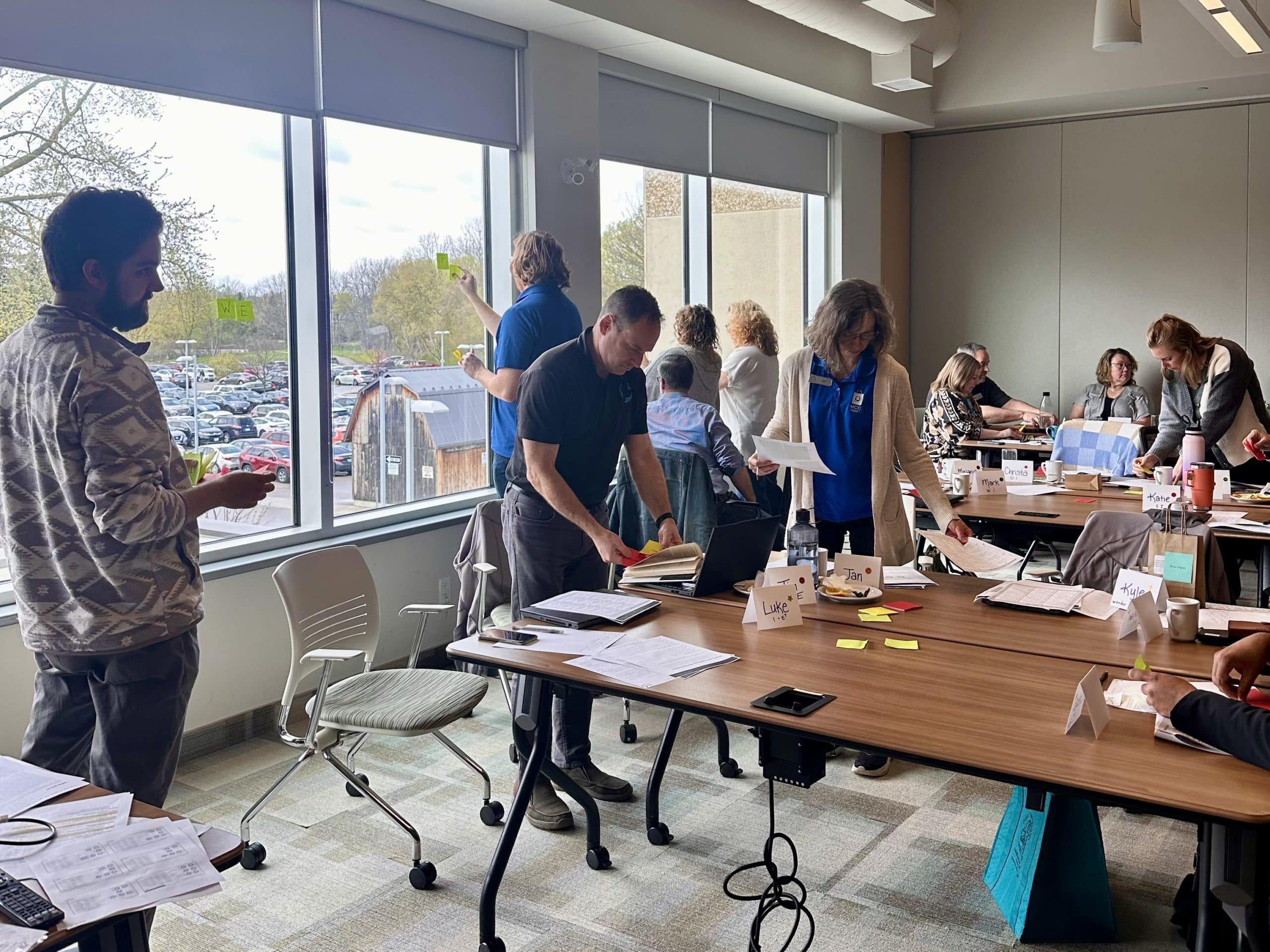
I have a great example of this playing out inside a Working Genius Workshop I was facilitating. Before we got into a brainstorming segment, one of the participants, a Discernment Tenacity with Wonder and Invention as his working frustrations, announced to the group that he hated brainstorming conversations.
He said they were too open-ended, the conversations bounced all over the place, and that he just wanted to get into the work. The share really helped others learn how different Geniuses think and what they enjoy.
When the breakout session started, I couldn't help but notice that Sam, the one who self-proclaimed he hated brainstorming, was one of the most engaged people in the room. He was offering ideas, listening intently, and building on the ideas of others. I would say he was fully in it.
Afterward I had to ask. "Hey Sam, you told us this wasn't your thing and yet I saw something completely different. What happened?"
He said: "I knew what was needed in the meeting and I know it's important. Also, it was only going to be 30 minutes so it was easy."
WOW. That's the lesson.
When people know the purpose of a conversation, understand what's needed from them, and feel free to contribute in whatever way they can, they show up differently. Maybe not to the extent that Sam did, but when a team member knows the goal of the conversation and their role in it, they can play it.
Most team tensions aren't personality problems and that's actually great news. It means the solution is closer than you think. When you can name the stage of work and understand what's needed from each person at that stage, you remove the invisible barriers that are quietly hurting teamwork and create the conditions for people to do their best work.
In this blog I've focused on meetings because that's where stage mismatches show up most visibly and most often. But the stages of work and the Six Working Geniuses apply to everything: your projects, your processes, your initiatives, and how work moves through your organization day to day.
When people know their role within the situation at hand, the work doesn't just get better, it gets easier. Without this awareness, most teams are operating with one foot on the gas and one foot on the brake at the same time. Everyone is trying to move the work forward, on the gas. But without alignment, they're doing it from different stages of work, on the brake. The result is friction that feels personal but isn't.
If you're curious about what this could look like for your team, I'd love to talk. Whether your starting point is the Working Genius Assessment or a conversation about where your team is struggling, I've worked with everything from a single leadership cohort session to a full organizational rollout. Reach out and let's figure out what makes sense for where you are.
Michelle Nicole Martin
Leadership Coach & Consultant
Connect with me on LinkedIn